
Writing process, unhinged progress, and beautiful disasters
Lessons in being a WIP on and off the page

I tried writing about just my writing process. I wanted to boil it down to a clear and concrete list of steps and methods anyone could follow. What I found was that while I could, it would be meaningless without everything that influenced my discoveries. It would be the equivalent of giving you the answer to a math problem without explaining how I got there.
In sharing, my struggles I hope that I can spare you some of the same. My process is unexpectedly and inextricably tied to how I think, feel, and live. This became more of a formula—a recipe, if you will—for finding strategies you can customize to fit your needs. This is a longer read than I intended it to because it touches on the most common obstacles the writers around me have expressed struggling with: plotting, motivation, and non-linear thinking. If that sounds like you, you’ll find it a worthwhile use of your time.
Deciding to write a novel rough draft was filled with a lot of firsts for me. It came with a lot of disappointments, too. I never imagined a goal I set for myself when I turned thirty would quite literally change my life in a year’s time. On the other side of it, it’s still hard to believe how much I’ve grown as both a person and an artist. This experience is the reason I named my Substack “Mother of Stories.” It truly felt as though I carried this rough draft through a mentally, emotionally, and physically taxing gestation period to deliver it to the world in a labor of love. My shared experiences are not revolutionary or ground breaking. All the same I hope I can make your delivery much smoother and more pleasant than mine was.

Step 1: Identify what you’re working with
It’s no secret to anyone that knows me that I have the directional aptitude of a concussed homing pigeon. (My husband says he finds it endearing, but I think that’s because his internal compass is flawless.) I have to do that little L thing with my fingers to know my left from right. Street names and directions just don’t stick.
I didn’t think being directionally and spatially challenged would translate into difficulty with things like outlining and planning. In hindsight, it makes a lot of sense why I struggled with every linear plotting method I tried. ‘Pantsing’ it and trying to discover my story naturally only got me so far before I’d feel lost. If I wasn’t aimless, I was throwing myself at writer’s block and bargaining with the muses and story gods to take pity on me. It was a vicious, demoralizing cycle of trying a new fool-proof method, failing at it, then trying another. I can vividly remember the existential crisis I had staring at my third attempt at a half filled out beat map.
It took me months to realize I was fighting myself on multiple fronts. I had my heart set on drafting a novel idea that I’ve carried around for the majority of my life. In my mind, I was first and foremost a fantasy author. I would not entertain my inclination to write romance. If I wanted to be taken seriously, that part of me had to stay sequestered with my indulgently smutty fan fictions far away from my ‘real’ work.
My neurodivergence was something I was still coming to terms with as well. I was still new to the revelation that I’m autistic and have ADHD. I celebrate those things now, and I truly love the way my perspective is shaped by those aspects of myself. At the time, I didn’t know how to accept and cooperate with those facets of my mind. It was daunting to try and make space for my ‘new’ needs. I had always had them, but was so used to ignoring them. I didn’t know how to tackle unlearning masking. Accommodating all my complex and contradictory needs and impulses seemed impossible.
In my overwhelm, shifted my focus to researching my favorite authors’ writing techniques. I poached the habits of wildly successful best sellers. I surveyed my writer friends for their tips and tricks. I read a ridiculous amount self-help books. So. Many.
It took a mental breakdown and half, two glasses of cab (okay, maybe more), sobbing to my spouse, and several homemade chocolate chip cookies for it to click that I was looking at starting my draft all wrong.
Just like my cookie recipe that I’ve tweaked and perfected over the years, I wasn’t going to be satisfied with someone else’s recipe for success; I was going to have to write my own. To do that, I had to be brutally honest with myself.
I had to admit that:
I actually wanted to write romance and fantasy
The novel I wanted to write was too ambitious for my inexperience
I needed consistency and structure that was flexible enough to not trigger task avoidance
I needed goals that challenged me, but didn’t make me too anxious to function
I had to maintain motivation that could withstand hurdles and boredom
I also had to take into consideration both my conscious and unconscious fears and expectations around my writing:
I was going to show up on the page whether I wanted to or not
I wasn’t going to write a perfect first draft (I still wished I would)
In fact, this would probably be some of my worst writing ever (It was. I still survived.)
There is no such thing as ready, just my willingness to start
A full draft was going to take a long, long time. There would be no rushing
These weren’t easy or pretty things to acknowledge, but identifying where I kept getting stuck was necessary to figuring out how to get un-stuck. This messy and unflattering snapshot of me made me realize that everything that shaped me would also shape my rough draft. If it was going to turn out anything like me, I had to learn to love both of us unconditionally at every step of the way, or we weren’t going to get anywhere at all.
Step 2: Don’t fight the chaos. Harness it
Let’s go back to my disastrous sense of direction. The way I get around is by using landmarks as references rather than street names or cardinal directions. To become comfortable on a route, I have to walk or drive it enough for it to become familiar. I interpret the world by understanding how everything and everyone relates to something or someone else. I learn by doing, feeling, and repetition. I measure by my heart in all things, be it distance, chocolate chips, or chapters.
To navigate my plot, I decided to use landmarks. These were the pivotal scenes that inspired the romantasy I ended up writing (not fantasy romance—there is a difference.) The landmarks were the moments that conflicts came to a head, the points where characters showed who they truly were, and the most gut-wrenching beats of their emotional arcs. They were they things I wanted readers to remember long after they put the book down.
I started by writing the middle of my timeline, and ideas I had for the end. I arranged everything else I had in an order that made sense relative to one another. This was the closest to writing anything linearly that I was able to do. My mind is a wanderer by nature. It doesn’t move from point A to B directly; it takes detours and meanders places I don’t always expect it to go. Having landmarks gave me a sense of direction in the vaguest sense. There was a ton of blank space between them, but the gaps didn’t feel so daunting with familiar waypoints to trace my steps back to.
One of the main issues I faced when trying to fill gaps was maintaining focus. A lot of energy and time was spent on trying to get myself to just sit still when I had time to write. There were days I had plenty of motivation, but a nameless resistance to actually writing (I later learned this had to do with struggling to initiate and transition between tasks). It was impossible to shut out the thoughts of everything that needed doing in my life: chores, grocery shopping, walking the dogs, etc. Even when I grit my teeth and typed, I was often frustrated that I wasn’t writing the things I ‘should’ have been writing.
In a fit of exhaustion, I just stopped fighting. I let all of it take me just to see what would happen. I went for walks that cleared my head and made space to work. I got a walking pad for my desk so I wouldn’t feel so restless. I let my mind wander while I did dishes and laundry. The ideas and peace that came from meeting myself where I was at began to flow more consistently. I realized that as long as I was writing something, even if it wasn’t the scene I set out to fill in, it was still a contribution toward the draft as a whole. It was what I wanted most: progress.
This discovery that following my attention instead of forcing myself to redirect changed how I used my energy.
I let myself stop and tap out frantic notes between appointments and in the middle of the grocery store (I feel obligated to clarify that I’m not an oblivious aisle-blocker). During bouts of insomnia, I got up to write instead of berating myself for failing so miserably at something as innate as sleeping. If I was going to be dead on my feet anyway, why not have something to show for it? I talked to myself while doing laundry, showering, or driving to get a sense for what characters sounded like. I let my daydreams come and go rather than shoo them away for ‘serious’ thoughts adults should have.
Sure, these changes externalized my erratic nature, but giving myself the freedom and grace to embrace my chaotic inner world outwardly was exactly what I needed. I started to feel like I had building material to use when constructing roads between my landmarks. I got to watch the gaps grow smaller, even if it was just by a page, paragraph, or even sentence.
I stopped caring if I was moving forward or backward because I was moving. I stopped judging myself for stopping in the middle of a chapter to work on a scene that I was suddenly had an idea for, or found more interesting. I do my best work when I’m fully and enthusiastically engaged, so I let myself be. Removing the judgment and the internalized sense that writing had to be done in a specific way helped me find the right headspace to create.
Step 3: Be disorganized, then sort it out later
Another quirk of my brain is that my thoughts move so fast that my speech and fingers can’t always keep up with translating them into words. Sometimes my vivid and overactive imagination overwhelms me with possibilities. At first, I believed I needed to pick a plot direction and stick with it. I realized that with how my landmarks were just free floating, it didn’t really matter how my characters got there. Why write one possibility when I can write all of them? I’m a visual person, so laying out all my options removed a great deal of stress and mental strain from trying to picture it all.
Sometimes this took a form of a brain dump in a separate document. I didn’t let myself worry or think about what went where. I just got it all down knowing I could sort it later. I stopped telling myself that writing scenes that might not get used was a waste of time. Maybe it was for other writers, but I needed it to decide if something was worth pursuing. I had to feel my way around, get a little lost, and decide if something was worth re-visiting after having been there.
Ultimately the material I didn’t use informed my understanding of my characters. I got to put them in situations they otherwise might not have encountered, and developed a sense for their voices, moral compasses (or lack thereof), and how they would genuinely react to anything.
What I had previously considered wasted time and energy ended up being some of the most useful exercises for getting to know my characters and the intimate details of their lives. They dropped bombshells about their pasts, whispered their secrets once we built up trust together, and admitted their deepest fears. Our mishaps gave us a chance to communicate about where they wanted to go and why getting there mattered. My characters were very vocal when they had adverse responses to my experiments, and would offer alternatives I hadn’t even considered.
I indulged Ferren’s and Silus’ rants and confessions until they finally convinced me to hand control over to them. I became less of a writer and more of an omniscient observer invited into their world. I was their cartographer bouncing around multiple time lines to tell them what happened if they did or didn’t do something. I fell into plot holes that I roped off to address later. I stopped being afraid of the unknown landscape and let myself be excited by the branching paths.
It was unconventional, illogical, and messy, but I was watching my story take shape with shocking speed. Most surprising of all, I was having fun again.
I hadn’t realized how much of a slog writing had become when I was tied to ‘should’s and ‘should not’s. Efficiency is a priority in my life, and it often bothered me that I wasn’t taking the most efficient route to my goal. The advantages I had were more than worth the price of optimizing my time. I wasn’t encountering writer’s block because I had many times, places, and paths to tread. I wasn’t getting bored because my world was so open. Ideas that intrigued me could sit in the back of my mind until they were something I could make sense of.
The main disadvantage was that I had to be intentionally and aggressively organized. I had to set aside time for ‘later’ when I said ‘I’ll figure it out later.’ Some days I didn’t sit down to write, but just to sort.
[IMPORTANT NOTE: Sorting does not mean making edits or revisions. This was a time for me to leave notes and ideas for changes at the top of the scenes they belonged to. It was when I popped in relevant fragments or developments without changing anything. For example, if I wrote dialogue then realized I had already written a worse version, I put it with the old version to fix in the next pass. I got in, then got immediately out so I wouldn’t give into the temptation of editing. I know I would not willingly climb out of that trap. Many a friend has warned me that’s the most common way writers can kill their motivation and rough draft. Now you’ve been warned, too.]
I found Scrivener helpful with keeping track of everything because it quickly became impossible for me to juggle multiple windows of traditional word processors. I personally need to be able to see everything at once. It isn’t the most intuitive software, but a few video tutorials made it simple for me to pick up. It was a plus that it was fairly easy to find a discounted promotion for it, and it was a one time fee versus a paid subscription. It also made it easier to keep track of my daily goals and overall wordcount instead of manually inputting it into a spreadsheet.
(This isn’t an ad, though I wouldn’t say no to a sponsorship. Your move, Literature & Latte.)
Oh wait, we haven’t covered goals, have we?
Step 4: Set goals that won’t make you abandon all hope
Goals were something I wrestled with because I didn’t know what was realistic in terms of writing. A thousand words a day might be feasible for some people, but not for me.
Neither did I know how long my novel should be. After a little bit of looking at averages for different genres, I settled on a goal of eighty thousand words. I tacked on an extra twenty thousand because I’m an over writer by nature. It was a little bit arbitrary, and definitely lofty (for me at least). Mostly I thought it was a pretty, round number and I just wanted to say I did it. Watching that little progress bar tick closer to one hundred thousand kept me motivated.
I wanted a way to hold myself accountable and consistently show up that still gave me some wiggle room if I missed a day or wrote less than I planned. I set a daily goal of five hundred words. It felt low enough that it was achievable, but big enough that it still felt like it was something. My monthly goal was ten thousand words.
Before you tell the math isn’t mathing—I know. That’s where some of the flexibility is. If I didn’t write on weekends, or if I missed a day due to lack of time and fatigue, that gave me a few thousand words I could miss without feeling like I was getting off track. I needed to avoid the sense that I was falling behind at all costs. If anything, I wanted to trick myself into thinking I was ahead of my scheduled deadline I set: my thirty-first birthday. (I started on my thirtieth in September 2024. You’ll see from the stats later that I didn’t start writing until well after that in March 2025.)
If I didn’t have a chunk of time to set aside for writing, I made do with what I had. Even if it was just two or five minutes, I set a timer and got down what I could. There were some days I felt like I didn’t know what to write or where to start. I doubted I had five words to give, let alone five hundred. If I lacked motivation, but not energy, I just picked a random place to start, then did a writing sprint.
Setting that timer became a signal to my brain to ignore doubts, allow my writing to be absolute garbage, and not consider if the dialogue or plot even made sense. If I wanted to stop when the timer was up, I stopped without guilt.
More often than not I kept going. The mere act of starting helped me overcome that inertia and made me excited about my characters again. The days I thought I wouldn’t do anything significant were some of my most productive days. It became both a habit of showing up, and honoring my limits.
Step 5: Adjust as often as needed
Mental and physical health impacted my progress heavily. I had to learn that some days I wasn’t going to get as much as I wanted done. There were many days I struggled to admit I couldn’t get anything at all done. Giving up on the idea of ‘pushing through’ was one of the healthiest lessons I’ve taken away from this.
Rest is essential. Period. It’s not a reward, treat, or something you can put off for later. It’s necessary. Without it, your body will break down. Being productive all the time is not sustainable. Pushing through on bad days sometimes meant losing a week because it made me sicker, caused me more pain, or put me in a lower headspace than I started in. I had to learn the discipline of relaxing and resting because worrying while sitting still does not count. I reframed rest from a waste of time to recharging.
Think of your energy as money in a bank account. You can’t spend money (in this case energy) you don’t have. Doing so means overdrawing and accruing fees you’ll have to pay. If you use credit or take out a loan, there’s interest to consider. Putting yourself in massive debt is easy to do, especially if you aren’t paying attention to your budget. You’d best believe your body will come knocking on your door with a bat if you don’t make your payments on time.
Kick your ‘grind mindset’ bullshit to the curb; your draft will grind you down first. A novel is not a mad dash to the finish line, but test of endurance, humility, and trust in yourself. Brute force and top speed will not serve you any better than it did me.
I had to let go of the guilt I held around not wanting to be perceived as lazy. Balancing, work, life, and responsibilities is exhausting. Sometimes it doesn’t leave a lot leftover to spend on writing. That’s okay. Rest is the only payday we can give ourselves at any time. It is an essential part of the process, and one of the most important ways to replenish our creativity.
This may be a point of contention for some, but I regularly and intentionally stepped away from writing in the middle of a flow state. It is very easy for me to hyper fixate on writing when I’m on a roll. I will skip meals, not drink water, forget I need bathroom breaks, forgo sleep, neglect personal relationships, and abandon hobbies if I am too focused on something. It becomes all I think about.
In the beginning, I was deeply afraid that if I didn’t write everything right there and then, I would forever lose the inspiration. I was terrified that someone else would write my story first and better than I ever could. I didn’t know what I would do if people thought the product of my blood, sweat, and tears was a measly knock-off. With all those fears hounding me, I pushed and pushed until I couldn’t ignore the toll it was taking on my mind and body.
So yeah. Flow isn’t the healthiest thing for me unless it’s done in moderation. To avoid spiraling, I had to actively be aware of my actions and set boundaries to protect myself from unintended harm.
I found it inconvenient to put and keep myself on a meal schedule (I don’t get hunger signals like most people). It was frustrating to have my reminder go off in the middle of an exciting chapter to take a walk. Interacting with people seemed so boring when I could interact with my characters. What I found was that stepping away was always good for me. It was a routine of self-care that kept me rounded and grounded in ways I hadn’t realized I needed in my life in general.
Experiencing the people around me and seeking out fun meant I had a steady influx of inspiration. Setting aside time to completely disconnect from writing meant I came back refreshed and eager. Sometimes I would watch a movie, have a conversation, or see a sunset that sparked something. It would set off a chain reaction that filled in a massive plot hole, or made something make sense again. (You know when you say or read a word too much it becomes gibberish? That’ll happen with your draft if you stare at it too long.)
Writing is inseparable from my identity, but it isn’t all I am. Neglecting all those other facets meant I wasn’t bringing my best to my art. It spared me (some, not all) bouts of frustration when I knew things weren’t working but I couldn’t pinpoint why.
Putting my fragile and fussy draft down, and walking away when my emotions ran high was always the healthiest thing for both of us. Rest is the not-so-secret ingredient that helped us both survive, and preserve my sanity. Making rest a priority and making breaks non-negotiable meant I became more observant, patient, and forgiving of myself, others, and my draft.
It made me mindful of how intensely I feel everything. I’ve spent my life being told I’m oversensitive, too much, dramatic, blah blah blah. I internalized every single one of those put downs and toned my senses down to the point of numbness. Getting back in touch with those parts of me that craved feeling and allowing myself to nurture them gave me an even greater capacity for creativity. Knowing myself, my limits, and acknowledging my deeply emotional nature opened my eyes to the unique strengths I possess. I became aware of the perspectives I bring to my writing, and how I relate to my characters. It helped me understand that I didn’t want to show up for them limping and sleep deprived. I wanted to be able to pay attention with all of me.
My routine isn’t one size fits all. Everyone has different energy levels that change daily, sometimes hourly. You have different needs than mine, and might bring vastly different strengths to the table. Only you can listen to yourself and figure out what your best is, and how much you’re reasonably able to spend. The only person that can absolve you of guilt over not giving a hundred percent is you. Whether it’s fifty, twenty, or two percent, it’s enough. (It’s not going to kill you to take a nap once in a while.)
I’ve come to redefine my best as what I can do without causing myself harm, which includes pushing myself to exhaustion. It takes practice to not to overexert yourself when it’s what you’ve considered normal up until now. Give yourself grace if you forget, or if you accidently push your boundaries. I promise it does get easier with time. Your body, and your draft, will thank you for you learning to responsibly budget your energy.
Step 6: What you put in is as important as you get out
Just like the quality of ingredients affects the final flavor of anything you bake, what you decide to put into your draft impacts the final product. It’s the first go, so your first instinct is most likely to not use the good stuff right away.
Go against it.
There were times I caught myself holding back because my plot began veering too close to an idea I wanted to use somewhere else. I stalled because some characters began to sound like ones from stories I’ve been wanting to write. I tried substitutions, but everything I used instead fell flat.
The more I mulled it over, the more I saw how well the ideas I’d set aside for other projects fit. They organically showed up because they belonged there. If I didn’t use them, I would be denying my draft its full potential. If this draft didn’t turn out right the first time, then I would at least know how those ingredients behaved and how I could use them better in the next attempt. If they didn’t work at all, I could omit them entirely. Either way, I wasn’t letting my concepts go stale in the back of the pantry.
Please, please, please use the good villain extract. I beg you to break out the quality lore. More inspiration will find its way to you if you use up what you have. It’s an endless supply. Too often I’ve told myself I would get around to baking, then life would interrupt my plans. I wouldn’t have time, or I’d forget and then the eggs would go bad. It’s upsetting enough to know I could have prevented that waste. I don’t think I’d ever forgive myself if I let my best ideas rot between the pages of my notebook, forgotten by me and unseen by anyone else.
Step 7: The secret ingredient
There were days I was convinced I would never finish. I’d discourage myself by dwelling on how my writing compared to novels that had entire teams behind its publishing. I couldn’t stand to look at my keyboard without some form of inferiority. The more days I let pass, the harder it was for me to imagine picking up where I left off.
One of my most unfortunate discoveries was that there was no magical moment of readiness. There was no motivation or inspiration that remained constant at all times. There was no hack that made my story write itself. The secret ingredient wasn’t glamorous, special, or all that secret. It was perseverance.
I guess it’s less of an ingredient and more like the oven. Showing up consistently keeps the temperature steady. You wouldn’t turn the oven off if something was only halfway done; neither should you stop showing up.
On the other hand, don’t think you’re being clever by cranking up the heat. I could tell the parts where I got impatient and rushed when I went back to read through. The quality suffered significantly.
I want to reiterate that a rough draft is meant to bad. I’m not talking about bad ideas that didn’t pan out, or the terrible ending I wrote because I couldn’t come up with a better one. I don’t mean the stilted dialogue that I can make pretty later, or that absolutely horrendous action scene.
Poor quality came from the empty things I wrote down just for the sake of seeing my wordcount go up. I’m talking about burnt delirium that went in circles to pad out scenes I could have left alone. In my hubris, I turned the broiler on. When my emotions ran high and my energy ran low, I charred passages beyond recognition. If I had just stopped when better sense told me to, I wouldn’t have deleted things that were probably fine in hindsight.
Just exercise a little more restraint with the dial than I did, and you’ll be fine.
It took ongoing trial and error to tell the difference between when I was being resistant and when I was truly tired. I finally my way to the middle ground where my draft could cook evenly, and I could retain my sanity. If I hadn’t, I would have ended up with a blackened brick of a rough draft.
Showing up was a choice I had to make over and over. The only way I would ever hold my published novel was to bring it into the world one word at a time. I found reasons to keep going no matter how petty, silly, or personal they were. There was a lot of whining and crying involved, but I always picked myself back up, dried my face, and wrote again. I did whatever it took to not let the fire in the oven go out.
And it paid off.
Step 8: Congratulations! Now comes the hard part
At the end of my wandering, baking, or labor—whatever analogy we’re going with at this point—I had a rough draft. It was underdone in the middle and burnt around the edges, but it existed. It was a crude landscape I’d traversed alongside my characters. I was overjoyed to see so much of me in its little face.
Holding a finished product didn’t immediately make me jump up and down with joy. I shut my computer off on a Friday without fanfare. I didn’t tell anyone except my husband. I didn’t feel much of anything.
It took me the weekend to realize I was in shock. Denial. I didn’t want to believe I was done, because I was scared of what came next.
I had been so focused on just finishing the rough draft that I hadn’t let myself truly consider what came after its birth. Now I had to raise this thing? I’d known that all along, but I hadn’t known it.
Suddenly I could only think about everything that was wrong. I held it out in front of me and squinted at this recipe-map-infant hybrid and realized I was in over my head. Then it hit me.
I’d finished something. I did what I had thought impossible for so long. Yes, it was messy, erratic, and needed a thousand tweaks to become more than it currently was. But it was real. It was mine.
The world will never see this version (my characters would smother me in my sleep if I even considered showing it publicly). It’s a bittersweet fact to swallow that this imperfect little thing won’t ever be loved or held by anyone else. I take comfort in knowing that it’ll still become the foundation of the final version. When everyone else sees a lovely and full-grown novel, I’ll be the only one to recognize the traces of the first draft it once was. I’ll still love it as much as I did when I first held it, if not more.

I swear I’m almost done
Figuring out a writing process has been an emotional roller coaster. I constantly bounced between believing I was on my way to being a bestselling author one day, and an abject failure the next.
If I had to boil it down to one thing that got me through it, it was learning to listen. To my focus, body, characters, needs, and feelings. I let myself try things until I found what felt right. I gave myself permission to be messy, imperfect, and delusionally optimistic. I let myself rest, but never quit. To give you an idea of what this looked like in practice, here are some screenshots of my statistics.
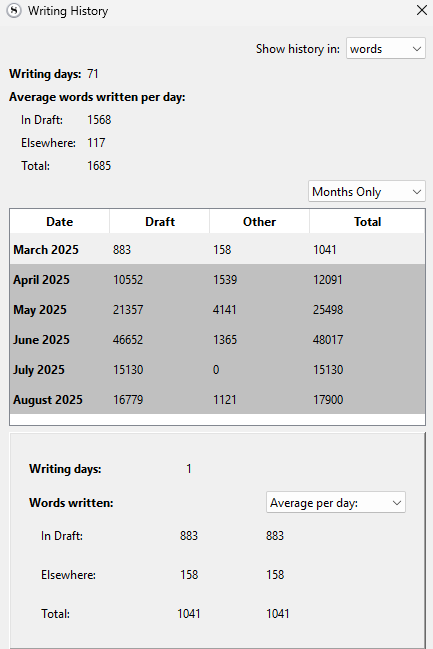
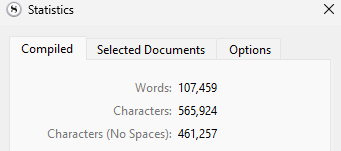

I ended up surpassing my goal because I stopped trying to make myself be anything but myself. It’s over one hundred thousand words that I’m in the process of completely re-writing. This is extremely long, so I’ll save the second draft experience for another post.
If I could change how I did things, I would make a bigger deal out of celebrating my little wins, like hitting milestones at every ten thousand words. I would tell myself to take more pride in watching myself and my draft grow. I would let myself acknowledge the courage it took to keep trying.
If you’re unconventional, lost, or feel like discovering your writing process is impossible, I hope you’ve found something resembling wisdom in my baking-cartography-parental anecdotes. I hope something clicks and helps you find your way. I mostly hope you finish that rough draft so I can read your story one day.
May the muses bless you with inspiration for indulging me,
Mother of Stories
If you’d like my insights on my current struggles with a second draft, let me know. Feel free to drop questions I didn’t answer, or ways you might want help finding a process that works for you.
In the future, I’d like to cover how I go about character creation and development, how I’ve learned to handle constructive criticisms, ways I keep my peace while pushing myself to experience things that are scary, and so many more. Feel free to follow if those topics interest you.
Excellently put words. I am glad I found you!